As Halloween approaches, outdoor specialist store Trailblazers is tracing the story back to the ancient Irish sites where Samhain, the festival that helped shape Halloween, is said to have begun.
Long before it was Halloween, the evening of October 31st marked the start of Samhain, the ancient Celtic festival that closed the harvest season and opened the darker half of the year. Ireland is home to the actual sites where this festival is said to have started, and several can still be explored on foot today. To trace its roots, Trailblazers has mapped the country's most significant Samhain landscapes, from a hilltop in County Meath to a cave in County Roscommon. Rebecca Ryan, Marketing Manager at Trailblazers, says that:
Most people know Halloween as a night of costumes and sweets, but its origins are far older and much closer to home than many realise. Walking these ancient sites is a genuinely different way to mark the season, and a reminder that Ireland's landscape has been telling this story for thousands of years.”
Ireland's Ancient Samhain Landscapes
The Hill of Ward, Co. Meath
- History: Known as Tlachtga, this hilltop just outside Athboy is recorded in Geoffrey Keating's 17th century chronicle as the site where the Samhain fire was instituted. According to Keating, every fire in Ireland had to be put out that night and could only be relit from this one. Excavations suggest the hill was used for feasting and ceremony from the late Bronze Age.
- Spooky Fact: Tlachtga was a druidess who, in one legend, died giving birth to triplets on the hill and was buried there. The Púca Festival (October 29th to November 1st, 2026) lights a Samhain fire in nearby Athboy inspired by the gatherings at Tlachtga, with guided heritage tours of the hill.
Rathcroghan and Oweynagat, Co. Roscommon
- History: Rathcroghan was once the royal seat of Connacht, with over 240 archaeological sites packed into roughly 6.5km². Among them is Oweynagat, a natural cave with a stone-built entrance passage whose lintels carry ogham inscriptions.
- Spooky Fact: Oweynagat, known as the Cave of the Cats, is described in legend as the dwelling of the Morrígan, goddess of battle, and as an entrance to the Otherworld at Samhain. Christian scribes later dubbed it Ireland's “Gate to Hell.”
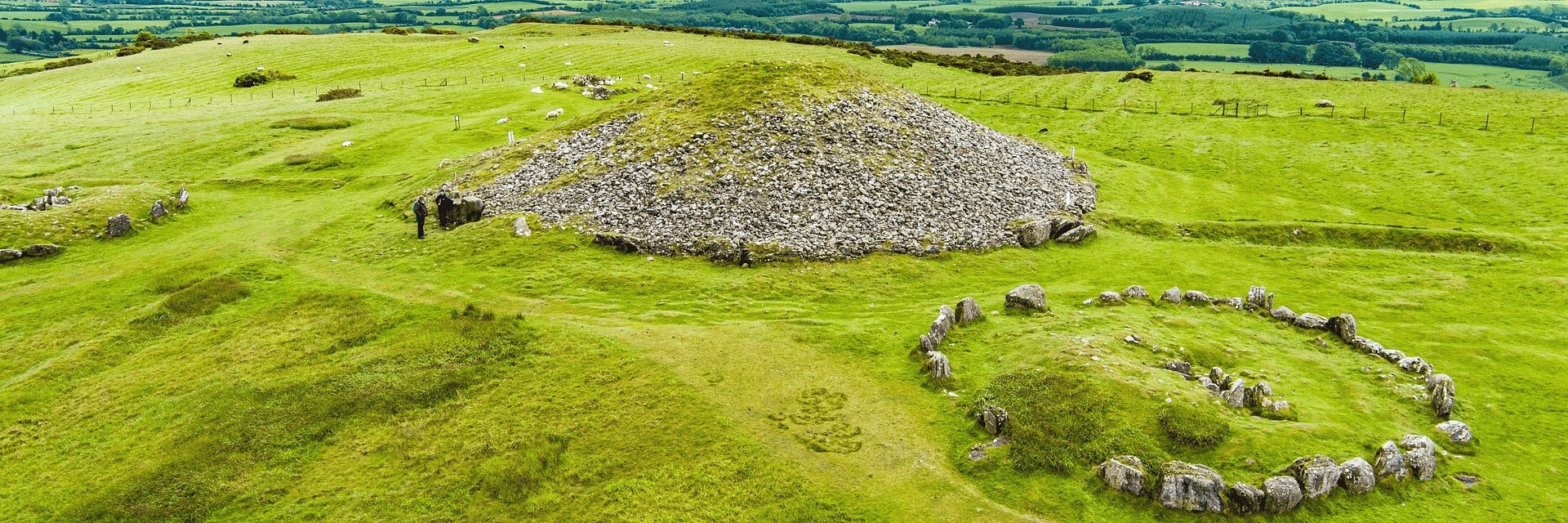
Loughcrew Cairns, Co. Meath
- History: Around 30 Neolithic passage tombs are spread across four hilltops here, dating back more than 5,000 years. Cairn T, one of the largest, is aligned to sunrise at the spring and autumn equinoxes, when the first rays light up carvings on the back wall of its chamber.
- Spooky Fact: The hill's Irish name, Sliabh na Caillí, means “mountain of the hag,” often rendered “hill of the witch.” Legend holds a giant hag built the cairns by dropping stones from her apron as she leapt from hill to hill, dying when she fell trying to reach the last one.
Brú na Bóinne, Co. Meath
- History: Newgrange, Knowth and Dowth are the best known of more than 90 monuments in this UNESCO World Heritage landscape, home to the largest collection of megalithic art in western Europe. Built around 3200 BC, Newgrange predates Stonehenge and the Egyptian pyramids.
- Spooky Fact: In Irish mythology, Newgrange (Sí an Bhrú in Irish) is said to be a dwelling of the Tuatha Dé Danann, particularly the Dagda and his son Aengus. Dowth, whose name means “darkness,” is known as the Fairy Mound of Darkness, and legend says a terrible darkness fell on it when the sorceress sister of a legendary king tried to stop the sun.
Carrowmore, Co. Sligo
- History: One of Ireland's four great passage tomb cemeteries, Carrowmore holds more than 30 surviving tombs built nearly 6,000 years ago, among the oldest megalithic monuments in Europe.
- Spooky Fact: Nearby, atop Knocknarea, Queen Maeve of Connacht is said to be buried standing upright in her armour inside a large cairn, forever facing her Ulster enemies. The cairn has never been excavated, though it is more likely to cover a Neolithic passage tomb.
Drombeg Stone Circle, Co. Cork
- History: Also known as the Druid's Altar, this stone circle of 17 stones is thought to date to the Bronze Age and is aligned with the setting sun at the winter solstice.
- Spooky Fact: In a recorded interview in 1979, local man John Hickey said he had heard the banshee nearby seven times, a sound traditionally taken as a warning that someone is about to die.
What's striking is how deliberately many of these places were built. Passage tombs and stone circles across the country line up with the sun's movement through the year, showing how closely early communities tracked the changing seasons. Samhain marked when the harvest ended and the darker half of the year began, a time associated with bonfires, feasting and the belief that the boundary with the Otherworld grew thin. Early Irish literature also describes it as a time when burial mounds stood open as portals to the Otherworld.
These sites reward a bit of preparation,” Rebecca says, “Several are open fields or hillside trails rather than paved paths, so the right boots and a warm, waterproof jacket make a real difference, especially once the evenings close in.”
Getting Ready for the Trail
For anyone planning a visit this October, a few essentials go a long way:
- Footwear: Waterproof walking shoes with good grip will keep you steady on stiles, uneven ground and muddy fields.
- Waterproofs: A waterproof clothing are worth packing given Ireland's unpredictable autumn weather, especially at exposed hilltop sites.
- Headtorch: A headtorch is genuinely useful if visiting at dusk, when many of these sites feel most atmospheric.
- Layers: Warm layers matter too, since standing on an exposed hilltop after sunset gets cold quickly!
- Plan ahead: Check access before you go. For instance, The Hill of Ward is on private farmland, Newgrange and Knowth can only be visited on pre-booked guided tours, Oweynagat is visited on tours from the Rathcroghan Visitor Centre and the interior of Cairn T at Loughcrew is currently closed for conservation work.
How the Data Was Gathered
Trailblazers compiled this list using published information from Heritage Ireland (OPW), Tourism Ireland, Discover Ireland and Discover Boyne Valley, with folklore drawn from published accounts. Site locations and monument records can be explored in the National Monuments Service's Historic Environment Viewer. Each site's history and folklore were cross-checked against multiple independent sources before inclusion.
About Trailblazers
Trailblazers is an Irish outdoor specialist store, providing walking boots, waterproof clothing and outdoor gear for adventurers across Ireland.